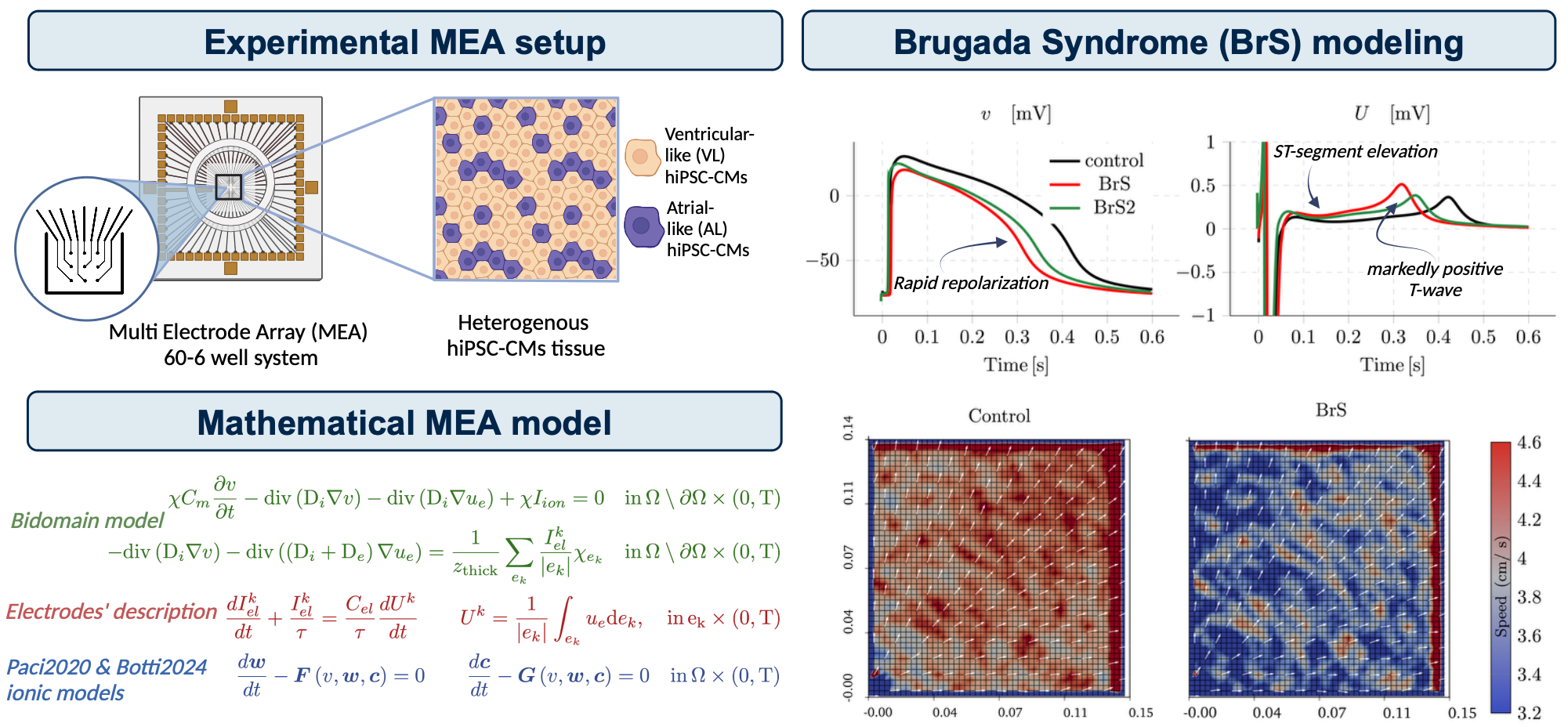
Cardiomyocytes derived from human induced pluripotent stem cells (hiPSC-CMs) are an appealing platform for disease modeling and drug testing, but they are immature, heterogeneous, and usually recorded on multi-electrode arrays (MEA), which measure extracellular field potentials rather than the action potentials we are interested in. I build mathematical models that connect these scales, from the ionic currents of a single cell to the signal recorded on the array.
This is a research line that I have followed since my PhD in Pavia, under the supervision of L. F. Pavarino, and that I led as Principal Investigator of an SNSF Postdoctoral Fellowship at USI. At the cell level, I developed a novel ionic model for matured and paced atrial-like hiPSC-CMs that integrates the IKur and IKCa currents, and I used in silico dynamic clamp experiments to study how the IK1 current reveals the phenotype of the cells and how electronic maturation can be achieved. These models are calibrated on experimental data from the group of L. Barile at Cardiocentro Ticino.
At the tissue level, I developed a bidomain model of MEA recordings in heterogeneous hiPSC-CM tissues, which allows us to test in silico the effect of drugs and of disease conditions such as Brugada syndrome. This model is the basis of a correlation analysis between field potential and action potential biomarkers, which aims at inferring the underlying action potentials from the signals that can actually be measured. The numerical side of this work, in particular efficient time-stepping schemes, is described in the page on numerical methods.
Funding

SNSF Postdoctoral Fellowship no. 217025, Cell-by-cell and bidomain models for cardiac derived stem cell tissue: innovative numerical and deep learning tools for regenerative medicine (Università della Svizzera italiana, 2023–2025). PI: S. Botti.
Software
The code of the atrial-like hiPSC-CM ionic model is publicly available, and the single-cell models are implemented in MATLAB. The MEA bidomain simulations are run with our MATLAB framework for MEA bidomain simulations, developed together with M. Favino.
Collaborators
- Dr. Claudia Altomare, Cardiocentro Ticino (USI-EOC)
- Prof. Lucio Barile, Cardiocentro Ticino (USI-EOC)
- Dr. Chiara Bartolucci, University of Bologna
- Dr. Marco Favino, Università della Svizzera italiana (USI)
- Prof. Rolf Krause, Università della Svizzera italiana (USI) and KAUST
- Prof. Luca F. Pavarino, University of Pavia
- Prof. Stefano Severi, University of Bologna
- Sofia Tonali, University of Pavia
Publications
Journal Articles

Conference Proceedings and Book Chapters